Lock and Key Enzyme
Since 1965 Carlson has produced quality award-winning vitamins minerals omega-3s and other nutritional supplements. Lock and key hypothesis.

Difference Between Lock And Key Hypothesis And Induced Fit Hypothesis Choice Questions Multiple Choice Lock And Key
The glove changes shape to fit the hand.

. Similarly the way one specific key fits into the notch of a lock and unlocks it. The simplest model of enzyme-substrate interaction is the lock-and-key model in which the substrate fits precisely into the active site Figure 224. The lock and key hypothesis models this.
By directly attaching to the cell surfaces of viruses or bacteria or by attaching to their toxins. Enzyme surface is. Lock and Key Model.
However current research supports a more refined view called induced fit. An antibody only attaches to an antigen if it matches exactly like a key in the lock of the antibody. The enzyme initially has a conformation that attracts its substrate.
A The lock and key model in this model the substrate has a shape matching the enzymes active site see figure 2 Figure 2 b The induced fit model the active site has a shape complementary to that of the. This model is similar to a person wearing a glove. As the enzyme and substrate come together their.
Apart from active sites enzymes have allosteric sites or inhibitor sitesInhibitors may join an enzyme at an active site or allosteric site. That is how antibodies detect the matching germs to initiate a fast response from the adaptive immune system. Once the chemical reaction within this lock and key arrangement has been completed the products are released and the enzyme is free to attract another substrate molecule.
For many years scientists thought that enzyme-substrate binding took place in a simple lock-and-key fashion. Enzyme and its Active Site. The docking process in which substrate is put into the active site like a key into a lock then allowed the team to.
Combining of enzyme and the reactant. Due to the existence of the active groups the complex formed decomposes to give the products. And the active site of an enzyme.
The induced fit model is a development of the lock-and-key model and assumes that an active site is flexible and changes shape until the substrate is completely bound. If a solution of sugar is left in. Paul Andersen shows you how to solve simple Hardy-Weinberg problems.
In the model the enzyme has been considered as a flexible active site that changes its shape in order to accommodate the substrate and facilitate the reaction. This latter molecule is known to bind to the enzyme and inhibit its activity. We offer more than 200 products designed with your familys unique nutritional needs in mind.
Enzymes are denatured at extremes of temperature and pH. The binding of inhibitors to allosteric sites modifies the structure of the active site thus preventing the binding of substrate to the enzymeThis process is called allostery or allosteric. The enzyme serves as the lock and the attracted molecule called the substrate is the key.
The rate of reaction for such a process is thousands of substrate molecules per minute. Lock and key hypothesis have a simple approach which says that the particular substrate perfectly fits into the enzymes cleft active site for the reaction to occur. During the 1980s and early 1990s.
In such cases the conformation of the substrate is. In the lock and key. The amino acid residues enable the enzymes active site to bind specifically with the.
The ALLHAT blood pressure trial compared the effects of three blood pressure-lowering drugsa calcium channel blocker amlodipine an angiotensin converting enzyme ACE inhibitor lisinopril and an alpha-adrenergic blocker doxazosinwith the effects of a diuretic chlorthalidone which was the control treatment in the trial. This model asserted that the enzyme and substrate fit together perfectly in one instantaneous step. The place where these molecules fit is called the active site.
They neutralize germs eg. He starts with a brief description of a gene pool and shows you how the formula is deri. Enzymes are denatured at extremes of temperature and pH.
Antibodies have three main functions. Hence this happens in two steps. The lock SARS-CoV-2 knows how to pick is ACE2 that appears on the surface of cells in the throat lungs heart kidney intestines and blood-vessel linings.
In this model the substrate is described as fitting into the active site in the same manner as a key fits into a lock. In many cases however the configurations of both the enzyme and substrate are modified by substrate bindinga process called induced fit. ACE2 is famous for among other things.
Enzymes are folded into complex 3D shapes that allow smaller molecules to fit into them. The substrate which has the opposite charge of the enzyme fits into the cavities just as a key fits into a lock.

Lock And Key Model Is Used To Describe The Mechanism Of Enzyme Action This Model Was First Proposed By German Chemist Emi Lock And Key Active Site Biochemical
A Level Biology How Enzymes Work Lock Key A Level Biology Biology Active Site

Lock And Key Model Of Enzyme Algebra Worksheets Enzymes Lock And Key
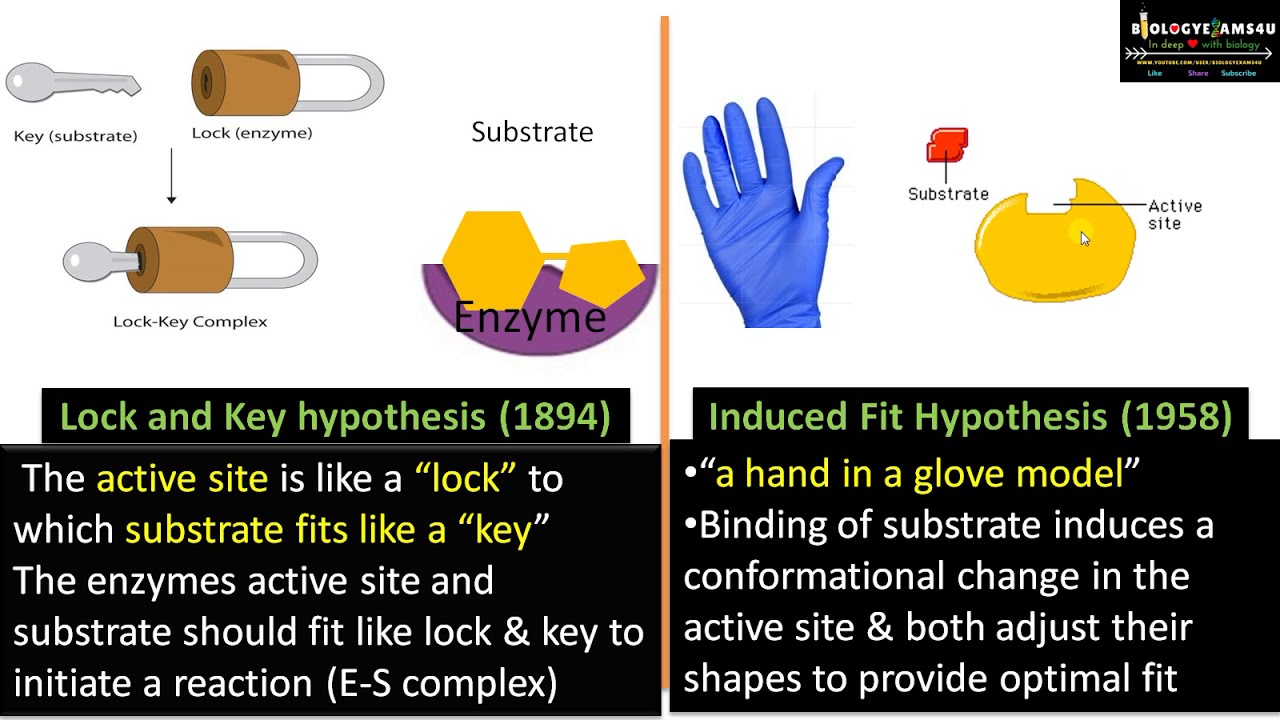
Difference Between Lock And Key Hypothesis And Induced Fit Hypothesis Choice Questions Multiple Choice Lock And Key
No comments for "Lock and Key Enzyme"
Post a Comment